[In the Spring AML612 course at ASU, we have discussed stochastic modelling methods, including Markov Chain Monte Carlo, Stochastic Differential Equations, and agent based models. Here we discuss how random sampling can contribute stochasticity to observed data]
Monthly Archives: February 2016
Simple agent based disease modelling with homogenous mixing
[In this module, we will describe a simple agent based analogue to a stochastic SIR compartmental disease model]
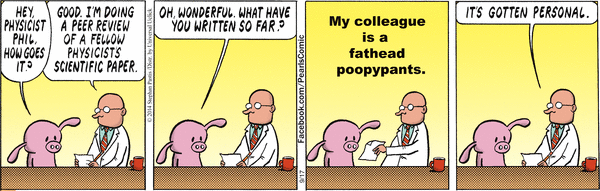
How to be a good reviewer and a good reviewee
[In this module, we will discuss the steps involved in reviewing a paper in an academic journal]

Protected: Data sources for firearm violence, social science, and life science research
Aggregating the results of a model simulation into bins of fixed time
[In module, students will learn how to aggregate model simulation results into bins of fixed time]
Combining stochastic modelling methods: MCMC and SDE’s
[In past modules, we have discussed Markov Chain Monte Carlo methods and Stochastic Differential Equations with Gaussian noise for stochastic modelling of compartmental models. In this module, we will describe how combing the two has the potential to simultaneously optimize computational efficiency and accuracy]
Continue reading
Stochastic compartmental modelling with Stochastic Differential Equations
[In this module, students will become familiar with stochastic modelling with Stochastic Differential Equations for compartmental models and how they compare and contrast with Markov Chain Monte Carlo Methods.]
A good, but much more mathematical, introduction to the material discussed here can be found in the paper Construction of Equivalent Stochastic Differential Equation Models by Allen et al (2008).